
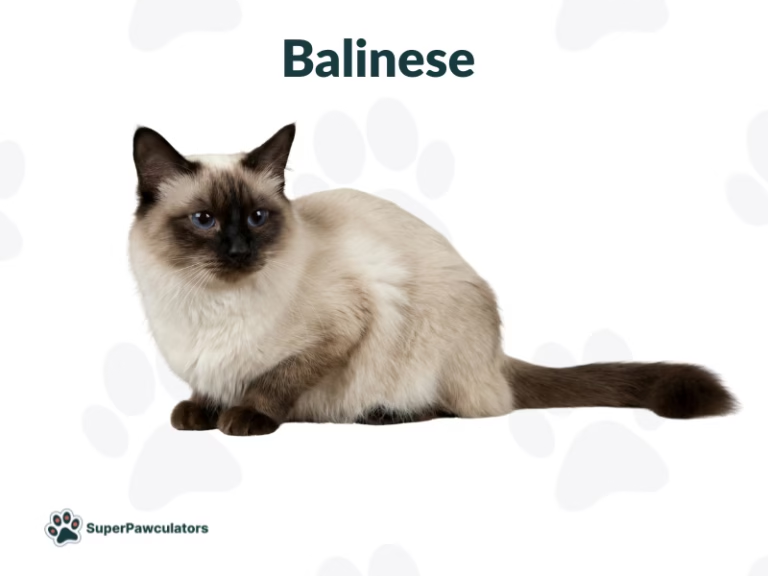
The Balinese cat is a svelte, elegant breed often described as a long-haired variety of the Siamese. Renowned for their striking blue eyes and silky fur, these cats possess an outgoing, interactive personality that makes them popular family companions. Despite their regal appearance, they are known to have a “clown-like” side and are deeply attached to their human families.
| Attribute | Details |
|---|---|
| Origin | United States |
| Height | 8 inches to 10 inches |
| Average Weight | 4 lb to 10 lb (1.81 kg to 4.54 kg) |
| Lifespan | 12 to 15+ years |
| Coat | Medium-length longhair, single coat, silky texture without an undercoat |
| Activity Level | High; athletic, agile, and energetic |
| Intelligence | Very high; curious, investigative, and easily trained |
| Price | $1,000 to $1,500+ (Breeder) $150 and $400 (Adoption) |
| Best For | Families with children, households with other pets, and owners who can provide significant attention and playtime |
HISTORY & ORIGIN
The Balinese cat did not originate on the Indonesian island of Bali; its history began in mid-1800s America. Purebred Siamese litters occasionally contained kittens with atypical, long hair caused by a spontaneous genetic mutation. Initially, these “fuzzy” kittens were considered faulty and were sold strictly as pets rather than breeding animals.
In the 1950s, breeders Helen Smith in New York and Marion Dorsey in California fell in love with these long-haired Siamese and began formal breeding programs to develop them as a separate breed. Helen Smith coined the name “Balinese” because the cats’ grace and elegance reminded her of Balinese temple dancers. In the 1960s and 1970s, breeder Sylvia Holland further refined the breed, selecting for traditional Siamese color points. The breed was accepted for Championship competition by the Cat Fanciers’ Association (CFA) in 1970 and was recognized by The International Cat Association (TICA) in 1979.

PHYSICAL CHARACTERISTICS
Body
The ideal Balinese is a medium-sized cat with a svelte, tubular, and graceful body. It should be lithe but possess firm, strong musculature, giving the sensation of solid weight without excess bulk. The hips should never be wider than the shoulders, and the abdomen must remain tight.
Head
The head is a long, tapering wedge that flares out from the nose in perfectly straight lines to the tips of the ears. The skull is flat, and when viewed in profile, a long straight line extends from the top of the head to the tip of the nose without any bulge or dip.
Ears
A striking feature of the Balinese is its unusually large and pointed ears. They are wide at the base and set to continue the lines of the wedge-shaped head.
Eyes
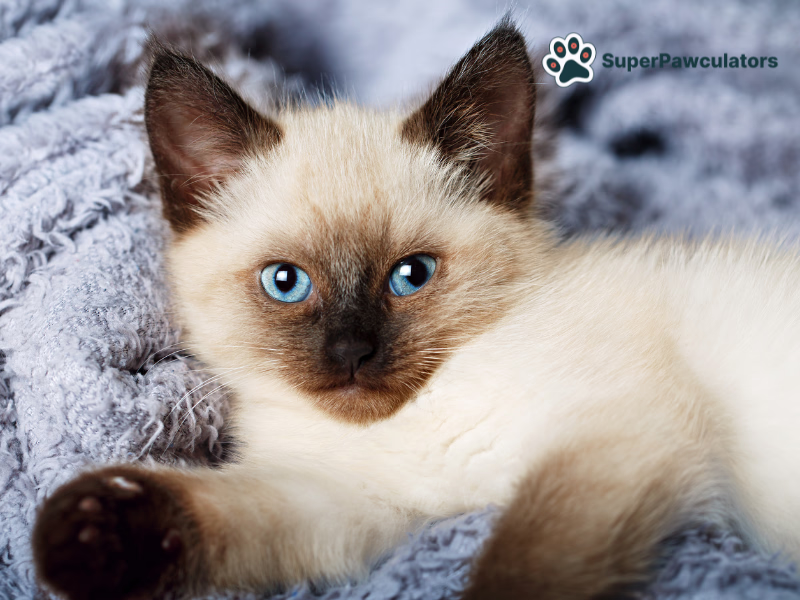
The eyes are almond-shaped and medium-sized, slanting toward the nose in harmony with the head shape. The most critical ocular feature is their color, which must be a deep, vivid sapphire blue.
Legs & Paws
The legs are long and slim, with the hind legs being higher than the front legs. The paws are small, dainty, and oval-shaped.
Tail
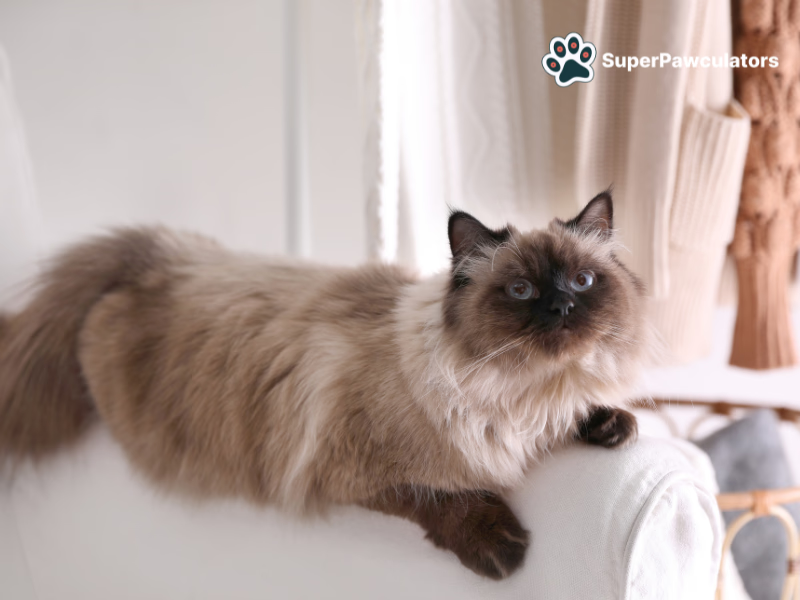
The tail is long and thin, tapering to a fine point, and is topped with long hair that spreads out like a plume. This feathery tail is the primary physical differentiator between the Balinese and the Siamese.
Coat
The Balinese has a single coat that lies close to the body, appearing shorter than it is due to the absence of a downy or woolly undercoat. The texture is fine and silky, with the longest hair occurring on the shoulders, frill, and tail.
Color
This is a pointed breed, meaning the body is a lighter color while the extremities the mask, ears, legs, feet, and tail are darker and clearly defined. All Balinese kittens are born white or cream, and their specific point colors begin to develop as they are exposed to cooler temperatures outside the womb.
DETAILED COAT & COLORS
The color palette for the Balinese is divided between traditional and non-traditional designations depending on the cat registry. The four “traditional” Siamese colors recognized by all major associations are:
- Seal Point: The points are a deep, dark seal brown (almost black) with a body color ranging from pale fawn to cream.
- Chocolate Point: Warm milk-chocolate points paired with an ivory body that stays pale throughout the cat’s life.
- Blue Point: Cold-toned deep blue or slate-gray points with a bluish-white body.
- Lilac Point: The palest of the traditional colors, featuring pinkish-toned frosty gray points and a glacial white body.
Following the merger of the Balinese and Javanese divisions in many registries, an expanded range of colors is now common. These include Red (Flame) Point, which features reddish-gold or apricot points, and Cream Point, a dilute version of the Red Point. There are also Lynx Points, which exhibit distinct tabby markings on the points, and Tortie Points, where the base point color is randomly mottled with shades of red or cream. The Foreign White Balinese is completely white but genetically color-pointed and must always have deep blue eyes.
PERSONALITY & TEMPERAMENT
Intelligence & Trainability
The Balinese is reputed to have the highest intelligence of all long-haired breeds. They are highly curious and investigative, often figuring out how to open cupboards or find hidden toys. Their sharp minds make them exceptionally receptive to training; they can easily learn to play fetch, perform tricks, and walk on a leash with a harness.
Activity Level & Energy
There is never a dull moment with a Balinese, as they are highly athletic and agile. They are world-class jumpers and will effortlessly leap to the tops of refrigerators, bookcases, and doors if high perches are not provided. Daily play sessions of at least 30 minutes are necessary to enrich their lives and prevent boredom.
Social Behavior
These cats are extraverts that adore people and want to be involved in every household activity. They will follow their owners from room to room, often “chatting” along the way. Unlike some breeds that attach to a single person, Balinese cats are generally friendly toward everyone and form close bonds with the entire family.
Behavioral Quirks
The Balinese is a vocal cat that enjoys carry on long conversations. While their voices are generally softer and more melodious than those of the Siamese, they are persistent and will “dish out advice” when they feel ignored. Some individuals exhibit “wool sucking,” a soothing behavior where they suckle on soft fabrics or blankets.
Compatibility Assessment
This breed is an ideal family pet that gets along well with children and other animals. Because they are so social, they do best in pairs or in households where another cat or a cat-friendly dog can provide company. They are not recommended for owners who are away from home for long periods, as they do not thrive in isolation.
LIFESPAN & LONGEVITY
While the average lifespan for the Balinese is cited at 12 years to 15 years by some registries, they are frequently documented as living much longer. A healthy Balinese cat with proper care and genetics has the potential to live 18 to 22 years, and it is not unheard of for them to reach their mid-twenties. Regular wellness exams and maintaining a healthy weight are the most critical factors in helping them achieve these advanced ages.
CARE REQUIREMENTS
Nutrition
As active cats with high metabolisms, Balinese require high-quality, calorie-dense food with real meat or fish as the first ingredient. Adult cats should be fed at least two small meals a day, while kittens require three to four feedings to fuel their growth. Because of their fine-boned structure, it is imperative to avoid obesity, which can shorten their lives by up to two years and cause early-onset arthritis.
Grooming
Despite their medium-long fur, Balinese are low-maintenance in terms of grooming. Since they lack a fuzzy undercoat, their hair rarely mats or tangles. A weekly brushing is usually sufficient to remove loose hair and control shedding.
Exercise & Enrichment
Mental stimulation is as important as physical exercise for this breed. Owners should provide:
- Cat trees and high perches to satisfy their climbing instincts.
- Interactive toys like teaser wands and food puzzles to prevent boredom-induced mischief.
- Puzzle feeders to encourage their natural hunting and foraging behaviors.
Environmental Needs
The Balinese is a naturally fearless and inquisitive cat that will investigate everything from a shopping bag to a running vacuum cleaner. Owners must “cat-proof” the home, keeping doors closed and blocking off areas where the cat might squeeze into dangerous spots like air ducts.
Socialization
Early socialization is key to developing their gentle, patient nature. They should be introduced to children and other pets gradually and respectfully. Because they crave attention, they should have regular interactive play sessions with their owners to reinforce their emotional bond.
FAQs
Are Balinese cats high-maintenance?
While their grooming needs are low, they are high-maintenance in terms of social interaction and mental stimulation; they can become destructive if they do not receive enough attention.
Do Balinese cats shed much?
They are moderate shedders; while they have long hair, the absence of an undercoat means they shed less than many other breeds.
What is the difference between a Balinese and a Siamese?
The primary differences are the length of the fur (medium-long for Balinese, short for Siamese) and the tail shape (a full plume for Balinese, tapered for Siamese).
Can Balinese cats live in an apartment?
Yes, they adapt well to small spaces as long as they have vertical space like cat trees to explore.
Are Balinese cats noisy?
They are very vocal and talkative, but their tone is generally softer and more melodic than a typical Siamese cat.